QUESTION 1. (Actually a whole series of related questions)
(We are asked this question several times a day - It is our most frequent question.)
Can I get the BBC and the ITV and Channel 5 on a free to air receiver?
Can I get the BBC, and ITV and Channel 5 on one receiver?
Can I use a freesat card with Sky + or Sky HD receivers?
Can I use the hard drive record facility in a Sky + without subscribing?
Can I use any other PVR (CI receiver) on Astra 2 like a Sky + or Sky HD?
Can I get Sky and other satellites as well on one receiver and on one dish?
Can I use a Sky Digibox for other satellites?
How big a dish do I need for Sky?
Can I receive two different Sky channels in different rooms.
Can the CI digital receivers be used for Sky TV and what channels can I receive?
Can I get Sky and other satellites as well on one receiver and on one dish?
Can I control two Sky Digiboxes through the TV eye system?
Problems with a Sky mini dish? Is it big enough?
Can I use a Sky + but use only one cable from the dish (e.g. using a splitter)?
What are the implications of getting Sky Q™?
ANSWER 1.
These are the most common questions that we receive. Many every day.
Here are the answers,
BBC 1 and 2 and 24 hour news, ITV etc. and 50 to 100 other free channels are all on the 28E Astra 2 satellite.
They can be received on a low cost freesat receiver. Prices start at £107.50
See. a
Freesat receiver
A freesat receiver is a dedicated product for the freesat channels on 28E and like a Sky receiver
which is another dedicated product, offers an extended program guide a week or more ahead.
See www.freesat.co.uk for a complete list of channels and more details on this package.
Probably the best freesat receiver is the
Humax 1100s. This is a twin tuner PVR.
These channels can also be received on any motorised receiver as motorised receivers work
with all free to air channels in the sky. However, an extended program guide may notl not be available.
Non-dedicated products tend to have a program guide that details what is on now and next.
There is an exception to this rule - The
Vu+ receivers. These is a non-dedicated receiver, ideal for multi-stellite
or motorised use, and offers an extended program guide on many channels and satellites through an "internet plug-in"
system. It also has hard drive recording capability through the program guide.
You do need to be quite good at IT to look for the different types of software for this "open platform" type of product.
Sky + or Sky HD need a subscription card otherwise Sky will not permit the use of the recording system
without at least a minimum subscription. Check with Sky for details of all Sky HD charges
Since the activation of a card or a
Sky + or Sky HD box requires a phone call to Sky, it is then
that they will deny access to the record facility without a subscription.
A Sky box also carries the Sky extended program guide that provides a large amount of program listing detail.
There are other single tuner and twin tuner PVRs which are not controlled by Sky.
See
www.satellitesuperstore.com/twintuner.htm and
www.satellitesuperstore.com/harddrives.htm
They will work on all free channels including the BBC and ITV etc. on Astra 2 and on other satellites
but note that although they do have an electronic program guide (EPG) it is not the same as the Sky EPG
A
Sky + or Sky HD needs a twin LNB and a second cable if you are to record one channel and watch another.
See
www.satellitesuperstore.com/skylnb.htm and See
www.satellitesuperstore.com/twinlnb.htm
Sky have their own box of tricks for their scrambling system and a Sky Digibox is needed for Sky Television.
A Sky box will also work on the free channels on Astra 2 but is not much good for free channels
on other satellites. For other satellites you need a free to air receiver or a Common Interface receiver
(also called a CI receiver – works on free channels as well). More info on this below.
Motorised receives are also CI receivers and work on all free channels as well. So all receivers of any
type will work on free channels like the BBC (providing the dish you have is the correct size)
There are two reasons why a Sky receiver is not ideal for use on other satellites than Astra 2.
1. It has preset frequencies, FEC and symbol rates. So if a channel on another satellite happened to
have a frequency, symbol rate, and FEC the same as one of the Sky channels,
then that channel on another satellite will work, however, since you cannot infinitely vary
the frequencies, symbol rates and FECs in a Sky Digibox like you can on all CI receiver,
then most channels will not work.
2. You may have difficulty storing channels in a Digibox if you move it from one satellite
to another. It is likely to forget the extra channels that you have tried to store.
The size of the dish depends on where you are. In most of the UK a Sky zone 1 45cm mini dish
is OK but does not work well in bad weather. In Scotland a Sky 60cm Zone 2 dish
is used (or an 80cm in Northern Scotland).
(A standard 60cm dish is best in the UK anyway for all-weather capability) From other parts of
Europe dish sizes vary and are detailed on our site at
The caravan page
or from the footprint details at www.lyngsat.com
The question about 2 channels and two or more rooms is really two questions.
For 2 channels at once you need two receivers, two subscriptions and a twin or 4
out LNB on the dish and an extra cable from dish to second receiver.
To extend Sky TV to two or more rooms you need a UHF distribution system in your home.
Or a wireless video sender system. These are detailed at
The Sky accessories page
Also see
advice page 3 about getting Astra 2, Astra 1 and Hotbird all on one fixed dish.
It would be possible to control several Sky receivers through the TV eye system as the handsets
can be set on different frequencies. A
multiroom combiner is however needed.
Alternatively, one box could be controlled through a TV
A standard 45cm Sky mini dish is at least 10% too small to do the job. The balance was to make it as
environmentally friendly as possible. In the North / Scotland a 60cm zone 2 dish should be used.
In all areas a 60cm is a better bet and since mini dishes have their own type of LNB / fitting the
wide choice of standard LNBs cannot be fitted.
The best solution is a standard dish like the Triax TD 54, TD 64 or clear 60cm. The 54 will be fine
for all areas in the UK except Scotland where the 64 is a better bet.
Another excellent solution is the clear transparent 60cm dish
See
clear transparent dishes
All will provide far better "all weather" capability especially in the winter. See the
fixed dishes page.
Sky + with a single LNB? No. Read question 20 below. Sometimes when we answer
this question on the phone it is then asked in 6 or 7 different ways in the
hope that asking in a different way will mean it is possible! it is not.
A twin LNB and two cables are required.
It is probably very worthwhile to read FAQ No 2 below, the Freesat question, if you want to receive
UK channels without a subscription.
(Please note - "Sky Q™" is a trade mark of Sky Television).
Sky Q™
If Sky come to fit Sky Q™ you will end up with a new LNB which will not work with other freesat
receivers you may already have in other rooms. However, if you keep your existing dish which will
have a quad LNB on it, and fit a
Sky Q™ interface, there will be two outputs from the interface for
your Sky Q™ box and two outputs for normal receivers.
Alternatively, if you connect the normal quad LNB to a
multiswitch and then connect a Sky Q™ interface
to 4 outputs of the multiswitch, you will then have the two outputs for Sky Q™ and many normal outputs
for several other standard receivers in other rooms.
Finally note, if customers have a standard dish on their house, or a standard dish for their caravan,
we sell
Sky Q™ LNBs for standard dishes.
We also sell
Sky Q™ multiswitches.
(Please note - "Sky Q™" is a trade mark of Sky Television).
QUESTION 1b
Can the CI digital receivers be used for Sky TV and how many other
channels in the sky are available?
ANSWER 1b.
In simple terms is best to consider that there are two types of digital satellite TV.
1. Dedicated receivers like Sky Digital. Sky has it's own box of tricks just for 28 east and
some channels are scrambled.
A Sky system includes BBC 1 and 2 BBC 24 hour news, Sky News, (free channels),
Scrambled channels include Sky 1, Sky movies, etc.
2. Common Interface Digital (CI). This covers the vast majority of everything else in the sky.
At present there are about 30 main satellites in the sky (of which the Sky Digital satellite at 28 E is
only one). On these many satellites there are about 8000+ digital channels from probably over 100
program providers (Sky TV is one program provider, freesat are another). Program providers that
scramble their broadcasts (not freesat) use about 6 or 7 scrambling systems and the
"decoder" is called a CAM. (Conditional Access Module) Maybe about 20 or so providers
use the same CAM and others use different ones. An estimate would be that about 1000+ of these 8000 or
so channels are not scrambled and are "in the clear". The rest need cards. Common Interface digital
receivers usually have two CAM slots. The card slides into the CAM and the CAM slots into one of the
two slots under the flap in the satellite receiver. Some CI receivers are for fixed dish use. Either a
fixed dish pointing at one or two satellites (e.g. Astra at 19E and Hotbird at 13E). Others used for
controlling a motorised dish. Many enthusiasts have a motorised CI digital receiver and
a Sky digital or freesat receiver as well. All of these products are on our site and can
be found from the links at the top of any page or from our main
catalogue contents page
QUESTION 2 FREESAT.
I am considering purchase of a satellite FTA HD receiver.
I would request your assistance in choosing such equipment to use primarily with Freesat but also
to receive other available FTA transmissions. Whilst reviewing this subject on the Freesat sites
and other related for a there seems to be confusion about reception of various Freesat channels.
Some recipients report that all can be received, including ITV HD and the ‘red button’ channels,
whilst using an established FTA HD box.
I would like to try this option, possibly with a PVR addition but am unsure of which one to go for.
I wouldn’t like to spend several hundred pounds only to find that I can’t receive all the Freesat channels.
Can Freesat receivers be used on other satellites? Can standard receivers be used for Freesat?
I would welcome your input to this subject.
ANSWER 2.
The new Freesat service on 28E.
The new Freesat boxes can be connected to a standard Sky Mini dish or any dish pointing at Astra 2 at 28E
although a standard 60cm dish does work better. Or the clear transparent 60cm dish
This service will include standard definition (SD) and high definition (HD) programs.
A full list of programs can be found at www.freesat.co.uk
Freesat is a new UK service and has a new dedicated electronic program guide (EPG) that is only applicable
to 28E and like a Sky receiver, provides detailed channel listings.
The EPG details program listings in advance and is considerably more detailed than in free to air, or CI, SD and HD
standard receiver. It is possible to record well in advance through the program guide using a freesat PVR.
Receiver advice.
There are 2 types of receiver,
1.
Standard receivers - These can be free to air receivers or Free to air with a card slots and or cam slots. These receivers
will tune to any channels on any satellites as they have the following software protocols built into them, Diseqc 1.0 and 1.1
(for switching between multiple LNBs and Diseqc 1.2 and USALS (for controlling a Diseqc motor on a motorised dish)
There is no extended program guide, only now and next. (However some receivers run a Linux operating system and it may be
possible to find a "plug in" online which can offer an extended program guide for various program providers but this does
need some research and IT skills.
and
2.
Dedicated receivers like Freesat receivers. These receivers (Like Sky receivers). They have been built and licensed by
a particular program provider. (A program provider usually has a number of channels on a satellite as do other program
providers who share the same satellite and there may be individual channels on a satellite which are not part of a package)
Dedicated receivers often have pre-programmed tuning capabilities and it may not be possible to scan in other
channels / frequencies at all (e.g. freesat receivers) of it you can, only the frequencies it lets you and not others
(like Sky receivers - if you scan another satellite with a Sky receivers it will only scan in a % of channels, once the
ones which coincidentally have the same frequencies as Sky channels).
Dedicated receivers usually do not have Diseqc 1.0, 1.1, 1.2 or USALS. Freesat and Sky receivers do not although other
receivers on other satellites may have. (e.g. The dedicated "Strong" receivers for the French TNTsat package do have
Diseqc and will tune to anything). Freesat receivers and Sky receivers are therefore not suitable for other satellites.
Dedicated receivers like freesat receivers do, however, come with a licensed extended program guide (epg) which looks forward
(usually about) a week. The latest generation freesat and Sky receivers also have an epg which can look backwards a week
(this requires and internet connection with a UK IP address). It is also called catch up TV.
Then there are single tuner receivers and twin tuner PVRs.
The latter lets you record one channel and watch another. Cheaper twin tuner PVRs may only have an external USB hard drive
option. The top of the range receiver from any manufacturer (flag ship model) is a twin tuner PVR with an
internal hard drive option.
There are receivers with a standard operating system and receivers with a Linux operating system
This does not apply to dedicated receivers (only from option "1" above). Some receivers run a standard operating system
and some receivers run a Linux operating system. The latter is more complicated, it is best if you have reasonable IT
skills but you are rewarded with more features - Examples are - better IT connect-ability, steaming, and control
from any computer in the world through a web interface.
Receiver Examples.
Good free to air (or card / CI) single tuner receivers -
(Note - single tuner receivers usually have USB and an external hard drive or USB stick can be connected so the the
channel you are on can be recorded now or later).
Low cost but plenty of features -
Edision Piccollo S2-T2/C
or
If a slightly larger budget is available -
CryptoBox 752HD
(The Cryptobox has an advanced DVB-s2X tuner and can scan in more channels using blind search than any other satellite
receiver we have tested on multi-satellite or motorised systems. Ideal also for satellite enthusiast feed hunters.
or
From a German manufactuer -
Technisat s6
(This receiver supports CI+ CAMs)
or
Linux single tuner -
Vu+ VU plus Zero 4K
Good twin tuner PVR receivers -
Ultimate twin tuner PVR (Linux) -
Vu+ Duo SE 4K
(The Vu+ Duo SE 4K has an advanced DVB-s2X tuner).
or
Ultimate twin tuner PVR -
Technisat Digit Isio STC 4K
(The Technisat Digit Isio STC 4K also supports CI+ cams).
Good dedicated UK single tuner receivers -
Freesat -
Manhattan SX
or
Freesat UHD-X 4K HD
or
Sky -
Sky HD DRX595
Good dedicated UK twin tuner PVR receivers -
Freesat -
Freesat recordable 4K
Sky -
Sky HD DRX895
Dishes in the UK,
If you don't already have a satellite dish or would simply like to receive many more channels, we would recommend
the use of a 60cm dish for the Freesat service.
See the Primesat
60cm dish
Why not get 2, 3 or 4 satellites all on one fixed dish - see
multi sat systems menu page
Also check out the clear transparent 85cm dishes on the
Transparent satellite dishes page.
QUESTION 3
I need to get Arabian channels or Indian channels or African etc.
i.e. Questions about channels. What equipment do I need?
(also see the next series of questions.)
ANSWER 3.
We need customers to do a bit of research themselves before asking the question, what equipment do I need
to receive a particular channel. If may be covered in the series of questions about channels below, but
If not you need to go to www.lyngsat.com This web site provides information on every channel in the sky.
We need to know which satellite the channels are on that you are interested in. www.lyngsat.com will help
you find this out. Once you know the
satellite it should be easy enough to advise you on what equipment you need.
From the UK we can see satellites from about 60W to 60W so it the sat is (e.g.) 115 degrees etc. we can't see it
Even if it is within 60E to 60W (e.g. African channels) you also need to check the footprints on this site as well.
see it is aimed at Europe.
QUESTION 4.
Can I get channels from the USA?
ANSWER 4.
There is very little American TV in the sky. Usually a few news channels.
It is very unlikely you would find a sport channels. To understand this you have to consider the Physics.
The Earth is round, not flat and microwaves (like light) travel in straight lines. Satellites above the
States are beyond our horizon. Only if US channels are relayed onto European satellites would we be able to
see them. This mainly seems to happen with free channels. Mostly news, however,
Fox Sport and Fox News are available in the clear from Pas 3 at 43 West. This requires an 90cm dish.
From the UK we can see satellites from about 60W to 60W so it the sat is (e.g.) 115 degrees etc. we can't see it
Even if it is within 60E to 60W you also need to check the footprints on www.lyngsat.com as well as the positions.
QUESTION 5.
I am British and I have moved to America.
Can I see British TV in America?
ANSWER 5.
This is not possible. The reasons for this are to do with the laws of Physics.
The Earth is round not flat and microwaves (like light) travels in straight lines. Satellites
above our horizon are beyond your horizon. Only if UK channels were to be relayed onto US satellites
would you be able to see them. You are in a better position to find that out than we are.
QUESTION 6.
I have an apartment in Spain. What do I need to receive Freesat or Sky TV?
ANSWER 6.
We now have a web page about this very subject. Go to the
"Getting Sky or Freesat in Spain page."
You need a freesat receiver or Sky Digibox, a card and a dish kit.
DISH SIZES IN SPAIN.
Dish sizes need to be quoted to receive every channel. Smaller dishes can be used and since
some channels are more powerful than others, the small dish will work on a percentage of
channels but not all of them. The BBC and the ITV are the weakest channels, and so unless
the dish is big enough to receive every channel, it will not be big enough to receive
the BBC and the ITV (although many Sky channels could be received with smaller dishes)
In addition it is important to note that there are 2 beams aimed at Spain. The north and
the south beam. The BBC and the ITV are not on the south beam but many Sky channels are.
The south beam can be received anywhere in Spain on an 80cm dish. To find out which.
channels are on the south beam go to www.astra.lu where you will you can research
what each beam carries on the Astra satellite. The North beam carries every channel.
As far as the north beam is concerned, customer feedback over the last year has provided
the following information on dish size recommendations.
Costa Brava 1.0m. Madrid, 1.2m Southern Spain and Portugal 1.1 - 1.6m. Alicante (weak spot) 2.4m dish
Close to Alicante - 30 miles south of Alicante 1.8m dish.
All we can do is relate to you customer feedback. It is your responsibility to check
yourself with people in that area as we cannot guarantee the accuracy of these recommendations,
Feedback from Gran Canaria.
Problems getting the BBC and other low power Sky Channels?
Our Solution worked. The customer had a large Andrews (Channel Master) dish.
We advised the customer to get a Andrews (Channel Master) matched feedhorn and 0.3 dB Invacom LNB on his
Channel Master dish. All channels now working great. (He replaced a 40mm 0.6dB Grundig LNB with
The new feedhorn and C120 LNB). See these items on the
LNB page.
QUESTION 7.
Can I get French TV?
ANSWER 7.
The old French analogue TV channels like France 2, TF 1, etc. are available from 5 degrees West in digital
in the clear. This requires an 80cm dish (and LNB) from the UK - east coast although bigger dishes may be
needed in the south west. See
the dishes page
M6 is no longer in the clear on 5W in digital but is in the clear on 7E but this would need a second dish.
Too far across the Sky for a bracket on one fixed dish so a motorised dish is needed to receive both
satellites on one dish. (The problem is, it is not possible to buy an analogue only receiver any more.)
To receive English channels as well as French channels from 5W and 7E you would also need a dish pointing
at 28E and so once again a motorised dish may be needed if a Sky mini dish is not already fitted.
There are a number of free to air French digital channels on the Hotbird at 13E and a small number on
Astra 1 at 19E. French channels that are scrambled are also available from Astra 1 at 19 east and the
Hotbird at 13 east. Providing a card and CAM are added the CI digital receiver will also work on these
scrambled digital channels. To do this an Astra and Hotbird dish of 80cm is required.
See
the dishes page Also see the French AB sat card for about
15 channels on 13E at
the foreign cards page. Since one of the French channels is an foreign channel,
the card is on the foreign cards page but the other 14 channels are not foreign channels.
There is a mix of good channels. Worthwhile checking it out.
UPDATE - Many French channels are still in analogue and are free on the 5W
satellite. We now sell brand new analogue receivers for this satellite and channels.
See
Analogue Satellite Receiver for French channels on 5W
QUESTION 7b
Do you sell the French AB Sat package card
for French channels?
ANSWER 7b.
Yes we do. Channels on this card include, Moteurs, AB1, Action, RFM TV, XXL (foreign), Anamaux
ONYX, Chasse & Peche, Musique Classique, Escales, La Chaine Histoire, Mangas, Encycopedia
Satellite information - Via Access - Hotbird at 13 E Freq 11.681 Pol. H S.R. 27500 FEC ¾
Dedicated classical music channel, A world of interesting documentary channels, Dedicated French motoring channel See,
Special order only on the phone.
QUESTION 8.
Can I get Russian TV?
ANSWER 8.
Information on Russian channels - customer feedback
Hi,
I have bought an Xtreme receiver from you back in October for use in Cyprus to watch Russian TV
(NTV+ package).. At the time you were not aware what combination I would require of card / cam.
I can confirm the receiver picks up FTA and pay channels from Eutelsat W4 on a 1.8m dish,
and with the proper subscription card and Via Access cam v2 the system works well.
I hope this helps should you need to sort out any Russian customers...I
can get the cards for £100 ( incl. 3 months subscription, then £20/month)!!
Update July 05
I'm just writing to you to tell you how pleased I am with your system.
I notice on your website the FAQs include how to receive Russian language channels but your
only answer refers to reception in Cyprus.
To receive free to air Russian (and Ukrainian) language channels in the UK I'd heartily recommend
your two satellite transparent dish system - just point it at Hotbird 13E and Sirius 5E instead of
Astra 19E and Hotbird 13E. I used a professional installer (he charged £80) but he described it as
one of the easiest installations he'd ever done despite never having had a request for Sirius before.
Hotbird will give you 7 free to air Russian language channels including Ch1 ORT, RTR Planeta, RTR Sport,
Music Box RU and Euronews. On its Europe wide footprint Sirius adds another Russian
channel Moskva Okrytki Mir and Enter Film (with has a choice of Russian and Ukranian soundtracks) and 7
other free to air Ukrainian Channels (including TRK Ukraina) many of whose programs are in Russian.
Sirius also has a Nordic footprint for which an 85cm dish isn't really large enough from the UK but
I've found the one free-to-air Russian language channel on the Nordic footprint (Baltic Music Channel)
has acceptable reception in all but the worst weather conditions.
Regards,
Ken
Always check www.lyngsat.com for latest information on any channels as over a period of time channel line ups change.
QUESTION 9.
What do I need to get Italian channels?
ANSWER 9.
Italian channels are mostly on the Hotbird at 13E. This needs a Hotbird system.
e.g. Choose the model of Technomate receiver you want on the
Techomate page and lower
down the page you add a Hotbird 80cm dish kit to complete the system. If you intend to fit it yourself,
you will also need some installation items (that an installer would normally bring with them),
cable, F connectors, coach bolts and plugs, clips and a meter. See the
installation equipment page
If you buy a free to air receiver you will get Ria 1, Ria 2, Ria 3, which most of the time are
free to air unscrambled channels and a number of other free channels from Italy. If you think you
might add a official card in the future the Technomate 1500 CI + or the 1000CI might be a better bet.
All of these items are very good quality receiving What Satellite awards and yet the prices are low.
QUESTION 10.
What do I need to get German channels?
ANSWER 10.
German channels are mostly on the Astra 1 at 19E. This needs an Astra system.
e.g. Choose the model of Technomate receiver you want on the
Techomate page and lower
down the page you add a Astra 1 60cm dish kit to complete the system. If you intend to fit it yourself,
you will also need some installation items (that an installer would normally bring with them),
cable, F connectors, coach bolts and plugs, clips and a meter. See the
installation equipment page
If you buy a free to air receiver you will get Sat 1, Pro 7, and many more, which most of the time are
free to air unscrambled channels from Germany. If you think you might add a official card in the future
the Technomate 5400 might be a better bet. All of these items are very good quality
receiving What Satellite awards and yet the prices are low.
QUESTION 11.
Can I watch 2 Sky satellite channels at once?
ANSWER 11.
To watch a particular channel in several rooms is not a problem and only needs one receiver.
The TV eye / cable / amps system as per
the Sky accessories page carries the signal
round the house with full control from every room.
However, to get one channel in one room and a different channel in another requires 2 receivers
(and 2 cards). People think this is in some way different to terrestrial TV but it is not. The reason
you can e.g. watch the BBC and record the ITV is because you have 2 receivers (tuners). One built
into the TV and one built into the recorder. (the laws of Physics for terrestrial also apply to satellite)
Also each receiver needs a signal from the dish and so a twin LNB must be fitted to the dish and a
second cable to receiver number 2. To have all this distributed around the house also needs the TV eye
system mentioned above. Then one satellite channel can be viewed in one room (and controlled) and a
second channel in the other room. If one receiver is a standard receiver and the other a Sky Plus,
the 2 remotes are different and will only control the appropriate receiver If a Sky Plus is used,
however, a 4 output LNB must be fitted and 3 cables as a Sky Plus needs 2 LNB feeds as it is also
able to record one channel while watching another. The 2nd receiver allows a 3rd channel to be watched
in another room. (May not sound simple but it works great.) Also Sky let you have the second card
at a discounted price. Since the second card has on it the same as the first card, if the main card
is a full package, the second card is very good value.
To do all this on a motorised dish, Use a 4 output LNB. One output for the CI digital motorised receiver,
2 outputs for the Sky Plus, and one output for the second standard sky receiver. Using a motorised dish
and a mini dish is better however as only this way can you watch one satellite on one room (e.g. Sky)
and another satellite in another room (e.g. Hotbird) as with a motorised dish,
it can only point one way at once.
QUESTION 12
Is there a twin LNB for a sky mini dish?
ANSWER 12
A Sky mini dish has a special fitting LNB. A 4 output LNB is available but not a twin. see the
Sky LNBs page
A standard 40mm twin will not fit on. The dish could be replaced with a Triax TD 64 (not expensive)
the dishes page and You could fit a twin 0.1dB LNB
see
the twin LNB page This is a better option
anyway as a Sky mini dish is only just big enough and a 60 cm offers all weather capability.
The TD 64 60cm dish is therefore also an upgrade. An inexpensive wall mount is also required.
(Also see dishes page)
QUESTION 13.
I've just been told by a Sky installation man that
we cannot have a Sky dish as the only place we can get a signal
is in the corner of the garden which is not acceptable to us.
We would prefer a dish on the house but suffer by being on the
south side of a hill just below some woodland. Do all satellites
send signals from the southern horizon or is there an alternative?
We are not that interested in hundreds of channels, nor in a
subscription to Sky but would like to improve our signal,
which at the moment is coming over the hill to us and so is poor
and without Channel 5 (no great loss). Can you help?
ANSWER 13
Sorry but you cannot alter the laws of Physics. Micro waves are electromagnetic radiation.
Just like visible light, they travel in straight lines and will not go through solid objects.
Use the space at the bottom of the garden. Some people do not have this option. You are lucky.
Appearance is an attitude of mind. In the USA the bigger the dish you can put in the front
garden the better. Status symbol! We suffer from British disease. i.e British reserve.
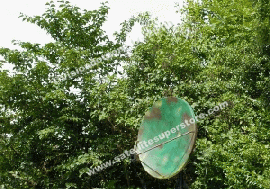
You could always paint it green to match the garden. Ordinary car spray will be fine providing
a thin single coat is put on the reflecting surface and it must be matt or it will reflect
light and heat as well as the signal. The heat will burn through the feedhorn cap and let
the spiders in. THEY BLOCK THE SIGNAL - use matt paint. Car primer is ideal.
Alternatively you could use a clear transparent dish. See clear dishes on our
clear dishes page
They are also very good for conservation areas.
ANSWER 13b
See above answer - "painting a dish." Below is the 1.0m Andrews (Channel Master) dish.
 QUESTION 14.
Can I paint a satellite dish to match
QUESTION 14.
Can I paint a satellite dish to match
the brick or stone work or garden?
ANSWER 14
This is answered in the previous question / answer above.
QUESTION 15.
Can I have satellite TV without putting a dish on my house?
I live in a CONSERVATION AREA - will it work through glass?
ANSWER 15
Yes it will but it must point south. There will be a small amount of atenuation through glass
but a 60cm dish is big enough for Sky TV even through glass. You could consider a transparent dish
see
the dishes page and the dish could be set
up in a porch, a greenhouse, a room in the house through a south facing window. (A clear dish
will not block as much light). You could even put it in a shed pointing through south facing window
or pointing through the door of a shed pointing south and simply don't close the door of the shed!
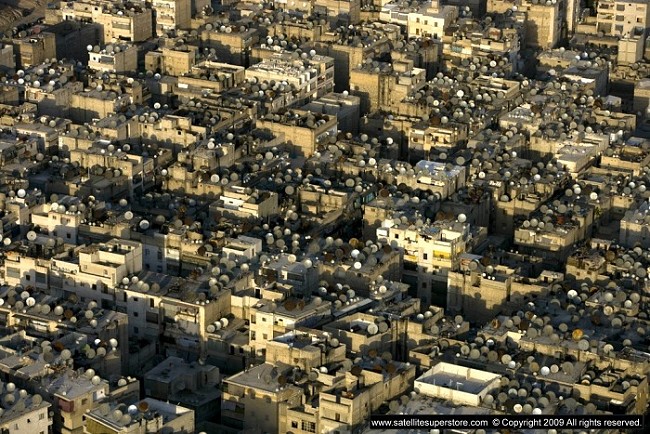
The picture below shows a town that is probably not in a conservation area!
 QUESTION 16.
Dear Sir, Do you supply foreign cards to my country?
QUESTION 16.
Dear Sir, Do you supply foreign cards to my country?
I think the customs might confiscate it.
ANSWER 16.
We are an international mail order company and supply direct. We regularly supply cards to
your country without problems. We use a fast international courier. Usually TNT International.
The cards can be found on the
foreign cards page
We prefer to "kick start" the card by turning it on and starting the years subscription
before it leaves here. That is a good way to test the card is OK before sending it.
Also check out shipping details on the
cards shipping page
If it helps we can write on the customs notes something that will not attract attention. Ring us for details.
QUESTION 17
What does a "blind search" mean?
ANSWER 17
To explain this it is necessary first to know what normal searching is.
To scan in a digital channel the Frequency, (and polarity, symbol rate, and FEC) must be entered
into your receivers "install" menu system. This is called scanning a channel (or to be exact
scanning a transponder) manually. (Digital channels are compressed and when one transponder
is scanned from one set of frequency data, up to 10 channels can appear from the one scan.)
A big satellite like the Hotbird at 13E has more than 1000 channels and so that means there
will be at least 100 transponders. That means at least 100 sets of frequency data would have to
be entered one at a time manually just on this one satellite.
All receivers will allow you to enter frequencies manually one at a time but the also
offer an automatic scan. That means that by simply selecting the Hotbird (for example) in the menu
and selecting auto scan, the whole of the Hotbird (in theory) can be scanned in.
So how does the receiver do this? What happens is that before the receiver leaves the factory,
it is loaded with software. This software is mainly it's operating system but, in addition
it also includes 100s of sets of frequency data that the manufacturer has prepared for you.
This data is collected from the satellite providers and other reliable sources and is usually
accurate AT THE TIME IT IS PREPARED. However satellites are constantly changing, channels move,
sometimes change frequencies, disappear, new channels appear etc. and so the frequency data is
changing all of the time. The 100 sets of frequency data put in for you, just on the Hotbird
first of all assumes the manufacturer found it thoroughly and accurately in the first place
and secondly is likely to have changed by the time the new receiver hits the streets.
To correct this problem manufacturers release new software on a regular basis. This
new software may well include - improvements in the operating system - fixes for "bugs" or errors
in the operating system. (Digital receivers are exactly the same as a computer. They are
driven by software and no software ever released is perfect as it is written by humans and
humans make mistakes) The operating system in a receiver (just like the Windows operating system)
is constantly being "fine tuned" and improved) - also embedded in the software will be the latest set
of "channel data". All the known frequencies from every satellite so that the auto scan will work.
On some receivers upgrading the software can be done "over the air" via a particular satellite.
Other receivers have to be upgraded by picking up the new software from the manufacturers website
and using (usually) a lead called a null modem lead, the receiver is upgraded via computer.
Either way, a receiver should be FACTORY RESET to clear all scanned in channels before new
software is put in as the old channel list will corrupt the new software and the operating system
will be screwed up. That is how a normal receiver works. For the vast majority of customers interested
in TV channels, this is fine. Upgrading the software once every 6 to 12 months would be the norm.
However, feed hunters have more demanding requirements. Now for Blind Searching.
This is a more thorough search. Instead of using an embedded set of data (that can go out of date)
the receiver scans EVERY possible frequency, polarity, symbol rate and FEC in the whole of the Ku band.
The big disadvantage with this approach is that it takes much more time. Instead of looking
at selected frequencies, all frequencies are searched. Instead of a standard scan on a big satellite
taking 5 to 10 minutes (standard scan) a blind search on the same satellite could take hours
or even letting a receiver search all night might be needed - just on one satellite.
It was therefore necessary to come up with a compromise alternative. Often called the
"Power Scan". Here the receiver has an internal data base of channel (transponder) frequencies
and a standard scan is done, but then a blind search is done on all of the frequencies not covered
by a standard scan. This approach can reduce scanning times for a big satellite to 30 to 40 minutes
In our experience, however, we are all relying on the manufactures software to be clever enough to
do this complicated operation and often the power scan is not clever enough and new frequencies
can be missed. It is however more thorough that a standard scan. Clearly the power scan also
benifits from regular upgrades from the manufacturer as it relies on channel data to improve
scanning speed.
It is now worth considering the history of the blind search receiver as sometimes I hear people
say things like "my cheap fixed receiver finds more than my expensive motorised receiver"
The very first blind search receivers were pure blind search and were very slow. We sold one
called a “Coship”. In addition, it only stored 1500 channels. Motorised enthusiasts used it as
a searching tool. They connected it to their motorised receiver via a LNB loop through
facility, or by fitting a twin LNB and extra cable, “scarting” the motorised to AV 1 on the TV and
the blind search receiver to AV 2. The Hotbird (for example) could be scanned (maybe overnight
for a big satellite) and then the data studied. Any new channels or feeds would than be noted
down and entered into the motorised receiver manually. The Coship would then be cleared
of all channels (factory reset) and then moved on the the next satellite to start a new blind scan
Many feed hunters still work this way. More inexpensive "no frills" blind search models came out
and later the power scan was introduced.
Manufactures found that by "tweaking the software" on many standard receivers (including motorised)
a power scan (combination of standard database scan and blind scanning) could be included as
a new additional feature. Very recently some "no frills" (budget) blind search receivers came out
that were "hardware blind scanning" rather than software blind scanning. This increased
the speed of the blind scan and a big satellite like the Hotbird could be scanned in around 15
minutes. The motorised enthusiasts now tend to use a hardware blind scan receiver
as used in a
Tehnomate receiver or a
Manhattan receiver
as a tool to update the data in their motorised receiver. At the moment
the feature packed
Technomate 6900 HD is the main 36 volt motorised receiver that includes
a good blind searching power scan feature but it still falls short of a dedicated hardware blind scan
receiver for the ultimate in blind searching capabilities. Blind searching is only a little
over a year old since it started. We have come a long way in that time and improvements are
continuously being developed. There are still "bugs" in the software of all receivers
(as there is in all software products)
Since 1998 when the digital satellite receiver started to be introduced in quantity, manufacturers
have made good progress and continue to do so.
Read a review of the Manhattan ST100 receiver.
Even if you want a different model, this review is worth reading as
it deals with blind search software that is common to all Plaza models.
QUESTION 18
What do I need for internet via satellite?
ANSWER 18
Sorry we only deal with satellite TV. For Internet via satellite, contact a company that specialises in this product.
QUESTION 19
I do not live in the UK.
How much will your products cost in my currency?
ANSWER 19
All countries have different currencies and if you order from a web site outside of your
own country you should check the exchange rate to find out how much you will be charged.
We don't know what the cost is in other people’s currencies. There are 100s of different
currencies in the world. The way you find out is to contact your credit card company.
Exchange rates vary on a daily basis and from one provider to another and so the only way
to know exactly what you will be charged on the day of ordering is to ask your credit card
company what they are going to charge you. They will apply the exchange rate, set by them,
on the day you ring them.
QUESTION 20
Can I use a splitter to split the signal from my dish
to two satellite receivers? and -
Can I use a twin tuner receiver like Sky HD or Freesat HDR etc.
with a single cable from the dish?
ANSWER 20
A splitter will not work Splitters do not do what people think they will do.
If you split the signal but the main receiver is then in control of the band and the polarity.
So - the second receiver only gets the channels that are on the same band and polarity as the
first receiver. That is about 25% of the channels But then if you change channels on the first
receiver to a channel on a different band or polarity, the second receiver then
also goes to the same band and polarity as the main receiver and goes to no signal
of the channel you were watching.
i.e. a different 25% of channels starts working.
One solution is a twin LNB or a second dish and another cable. Twin LNBs are
on the
twin LNB page. Cable on the
satellite cable page
An alternative solution is a
Stacker Destacker if it is very difficult to fit a second cable.
The limit to this solution is a distance of about 30m and a twin LNB is still needed.
The
Stacker Destacker does, however, enable one cable to be used.
only one cable from dish to the inside of the building.
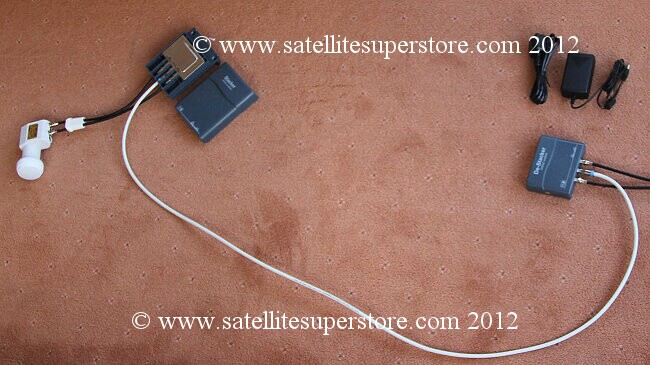
Left to right above - twin LNB, Stacker, single cable (WF100) Destacker (with power supply)
output two cables .... to two receivers or a twin tuner PVR. Only one cable is used.
The twin LNB connects to the Stacker and the output runs down a single cable. Indoors the
single cable connects to the Destacker and the two outputs connect to two inputs of the
multiswitch. To repeat, only a single cable is used between the Stacker and Destacker.
A maximum cable length of up to 40m is advised.
Also see the new Unicable LNBs on the
Unicable LNB page (or SCR - Single Cable Router LNBs). These LNBs
use one cable from the LNB to the receiver and then split to (up to) 4 independent outputs. This provides
a signal to 4 single tuner receivers or 2 twin tuner receivers PROVIDING the receiver have Unicable software.
Only a few receivers have this software capability. The range of
Manhattan Plaza receivers will work with this system.
Update 30th March 12. We understand Sky TV is now putting
unicable software into Sky Digiboxes / Sky + HD.
QUESTION 21
I live in a listed building and we are not allowed to put up a dish.
What are my options?
ANSWER 21
Ways of putting up a dish when you are not allowed to put one up.
1. In a greenhouse. Signal works through glass. Read the FAQ about this.
2. Build a shed in the garden with the door pointing south. Don't shut the door.
3. Point a transparent dish through a south facing window. See the caravan
dish kits at
the caravan clear dishes page. they are ideal for this. The clear dish does not block the light.
What is the most important to you. Having a dish in a (maybe spare) room or watching Satellite TV? Up to you.
Why not also check out the range of
Selfsat antennas?
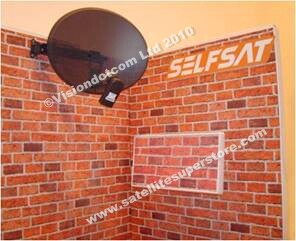
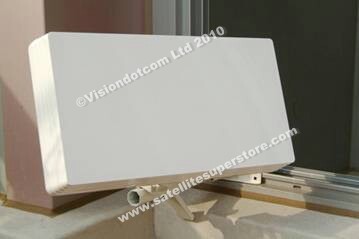
These flat plate "dishes" are not dishes and should be exempt from normal regulations.
 QUESTION 22
We live on a narrowboat in a marina on the Ashby Canal. When we are out
QUESTION 22
We live on a narrowboat in a marina on the Ashby Canal. When we are out
on the canals/rivers, we somtimes cannot get a signal to watch the tv.
We have a digital arieal one used on houses, if we have a dish, would we be able to
pick a signal up better with the dish, or would we need a signal finder or do they
only work on Sky systems. Also our tv is HD Ready and has built in freeview,so do we
need a HD freesat receiver box to receive HD broadcasts?
Janet
ANSWER 22
Hi,
This question is the same as for caravans and so everything is on
the caravan page
please study this page.
In the UK a 60cm dish is recommended for all-weather capability.
Option 1
A 60cm dish kit with deluxe stand, compass, made up cables, etc.
see
the clear 60cm kit and
the triax solid 60cm kit
you also need a satellite meter.
Read
meter advice and check-out the meters on the
satellite meters menu page.
possibly the Teleco meter or the Sam-Lite
Finally you need a satellite receiver.
The Grundig HD is also 12 v so might be ideal see
the 12v Grundig HD
Option 2
A self seeking dome.
See the
TracVision R4 self seeking dome
with the
12v Grundig HD
Option 3
A tracking dome.
See the
TracVision R5 tracking dome with the
12v Grundig HD
QUESTION 23
Should I use a Sky Mini dish or a standard dish?
ANSWER 23
Problems with Sky mini dishes.
As a general rule they do not provide enough signal in poor weather locations. We would estimate that a zone 1 mini dish
is about 10% too small even in southern England. Maybe that is why hardly a day goes past without a call from a customer
complaining of lack of signal, pixilation, freezing and drop-out (even on good days) and asking for a better solution.
Standard dishes fit a vertical pole of a standard wall mount and the LNB is held by a 40mm clamp. This allows higher quality
standard 40mm LNBs to be used. (Like Titanium or Inverto LNBs.) Standard dishes have been sold worldwide since satellite
started (in the UK in 1985). Non-standard Sky mini dishes started around 2001 and Sky have changed the design of their
dish at least 10 times. They use a non-standard wall mount and LNB fitting particular only to Sky mini dishes. If a Sky
mini dish LNBs is fitted, there is little or no choice of LNBs. High quality standard LNBs from countless manufacturers
cannot be used. Twin and quatro LNBs cannot be fitted to Sky mini dishes. Sky don't make them. Customers with early Sky
dishes can no longer buy the different non-standard early Sky mini dish LNBs for their dish and are forced to change the
whole dish when an LNB fails. This is because the latest Sky mini dishes have changed yet again and the latest Sky mini
dish LNBs no longer fit earlier dishes. The earlier types of Sky mini dish LNB are no longer available. The same is true
of spare parts. A standard 40mm clamp LNB will fit a standard dish from when satellite started. The same is largely true
of standard wall mounts. The only real advantage of a Sky mini dish is it tends to be cheaper than a standard dish. Sky
mini dishes are prone to severe rusting in high salt areas but the heavy duty standard range below is designed for that
type of location. For all of the reasons detailed above we would recommend customers use a standard dish for Sky, freesat
or any other satellite reception application. Examples of standard dishes -
Primesat Easy Fit high quality 60cm dishes.
Primesat Easy Fit high quality 85cm dishes.
Primesat clear transparent standard 85cm dishes.
Triax Heavy duty standard 60cm, 70cm and 90cm dishes for high wind and high salt areas.
For all-weather capability in the north (e.g. north of Newcastle Upon Type and Scotland) use
a 60cm, 70cm, 85cm or 90cm standard dish.