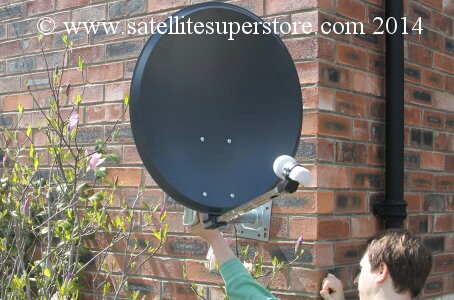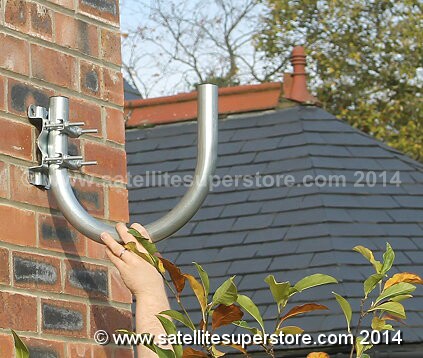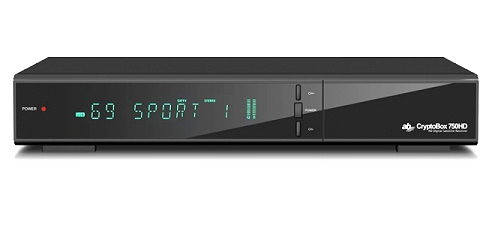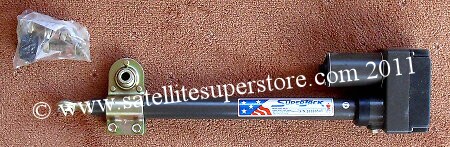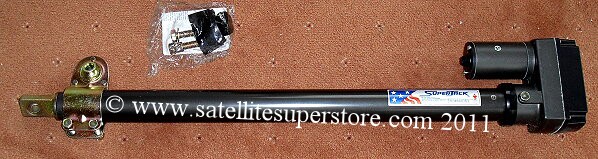


A high quality stand alone dish positioner. 36 volts. 5 amps. Works with read sensor or optical sensor
Also ideal for the vertical jack on an inclined orbit 1224 EL motor. (Above)
An East-West positioner for 36 volt motors. Ideal for installers.
When setting up a motorised systems this unit will allow the installer adjust the motor east and west
while setting up the dish. Input 220 / 240 volts. Output + or - 36 volts.
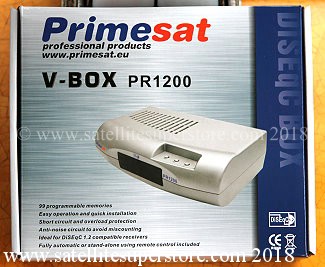
for converting Diseqc positioning to 36 volt positioning.
Advice on Motors.

This is where digital receivers now contain software to control a Diseqc motor (right hand side in photo) rather
than a hardware positioner board to control a standard 36V motor (left hand side in photo) motor.
There are, therefore two types of motors. Diseqc motors and 36 volt motors.
36 volt motors are designed for larger dishes. They inject more power down a separate cable.
We would recommend a Diseqc motor on dishes up to 90cm steel or 1.0m Aluminium as long as the
1.0m dish was not in a very exposed location. A Sheltered location would probably have a wall behind it
An exposed location would be a high pole above the gutter.
There are Diseqc motors with nylon gears and Diseqc motors with metal gears.
There is nothing wrong with nylon gears. Some big 36 volt motors on 2,4m dishes use nylon gears.
They are very quiet and strong. We have sold the Technomate 2100/2200/2300 with nylon gears
for many years with virtually no problems at all. Never see them again. Very reliable.
Some Diseqc motors use metal gears. Since a Diseqc motor cannot be made any larger as only the LNB
current is available to drive it, it can be made a little stronger with metal gears but they are a little noisier.
For that reason we would recommend Diseqc motors for 1.0m and 1.1m dishes.
For 1.2m and larger dishes, 36 volt motors should be used.
The Technomate TM-2300 and TM 2600 motors
The 2300 uses nylon gears and the 2600 uses metal gears.
Compared to other Diseqc motors, there is no noticeable play in the gearing in Technomate motors.
They also tend to be a little faster. They hang from above (like an elephant trunk) which makes
installation easier.
The problems with Diseqc motors and why the V box is so necessary with larger
dishes.
Diseqc is a development where digital receivers now contain software to control a Diseqc motor rather
than a five amp hardware positioner board to control a standard motor. The motor control works digitally
down the coax signal lead and a 4-wire control system is not required. Also the concept has become an
industry standard. Sounds good so far but what are the drawbacks?
1. The coaxial cable is designed to carry the signal from the LNB to the
satellite receiver. It is also designed to provide power to the LNB. The satellite receiver provides about
500 to 600 mA (0.6A) to power the LNB. Typically an LNB might draw about 300 mA. This leaves 200 to 300mA
(0.3A) to power up a Diseqc motor. Clearly a proper hardware (4 wire control system) positioner which
can provide up to (typically) 3 to 5 amps can drive better bigger, stronger, quicker motors.
With 300mA a Diseqc motor must be smaller. The only way a very smaller motor can move
a dish is by putting a large gearbox on the end of the motor to provide "leverage". This means that
a Diseqc motor moves more slowly from one satellite to another due to the large amount of gearing.
Diseqc motors should only be used on dish sizes that are within the ratings outlined above.
Our opinion of a recent conversation,
I was talking to another dealer the other day. He said he fits a Diseqc motor to the Andrews (Channel
Master) 1.2m dish face. The Channel Master is a heavy dish and the wind loads on a 1.2 can be massive.
In addition, this Channel Master dish is available with a wonderful heavy duty Channel Master
polar mount and actuator (or the big 15 Kg 1224 Supermount H to H motor.)
and yet this dealer fits a Diseqc motor to this large 1.2m dish face! (It is like ordering a
6.5 litre Rolls Royce from a dealer and saying "will you please fit a 1 litre engine before supplying it."
Unfortunately many dealers (and some magazines) are prepared to go down this route. What we need
is a bit of common sense. Why is wind load never considered? Every year we see numerous insurance claims.
Our recommendations.
For motorised use, The Diseqc motor works fine on steel dishes up to 90cm and aluminium dishes up to 1.0m
in "normal" locations. For larger dishes, or exposed locations (e.g. above the gutter on a high pole
or on the west coastline of Scotland or Ireland,) or for larger dishes use a V Box and a 36v motor.
Information from Jan 04
We have tested a new "Cryptic" Diseqc motor last weekend.
The reason for testing it was that for the first time a motor became available
that bolted onto the back of a 1.0m aluminum dish. Being a Diseqc motor
it was expected that it would still be slow (and it is) but this looked
very promising as the big problem of “universal fit – fits nothing properly
and slips in the wind had been overcome. We really wanted this solution
to work for us. It was set up with a Digiquest 8000 and using the USALS
facility all satellites were programmed in. Looked great.
However !
Taking hold of the edge of the dish, (at a distance of about 0.5m from the centre
Of rotation) there was play (movement) of about 7 mm. This was found to be in
The actual motor shaft between the rotating output shaft and the motor body
(i.e. in the gearbox) Looking at the shaft the movement was about 0.5 of a degree.
Now - last Saturday there were moderately winds (not gale force) and the dish
Moved on and off the satellite (no signal) every few seconds. Not a “peaky”
Low power satellite! We were on the Hotbird.
We contacted the supplier and were told that there is a certain amount of play
In all Diseqc motors as they use a worm drive to gear them down.
(small low current motor – large gearbox)
The only time you might get play in a 36 volt motor is when it has been used every
day for many years.
A typical e-mail. (Dated May 03)
Dear David,
Did not believe in UFOs until recently, when looking through my window I saw a UFO descend
vertically and crash. I soon found it was my 1.2 metre Channel Master dish, still firmly attached to top of
Jaeger mount, having left behind rest of mount, still on top of pole. If you will examine the
top plate of a 128, you will find it is held on by 4 small countersunk screws. In my case,
wind on dish had managed to tear the heads off inadequate sized screws. If you check 128
you will my point, that screws are too small.
Reply,
The 128 is a 36 volt motor but it is still too small a motor for the Channel Master 1.2m
as it only weighs 4 KG The correct motor (2 types) - both weigh 12 KG each
So nothing you say here is a surprise to us as we tell people that every day of the
week and follow other dealers insurance claims round. You should use the Channel
Master polar mount and 12 inch actuator or the 1224 motor with plate.
Update July 06
The Technomate TM-2200
We have tested the latest Technomate Diseqc motor and it is better than any previously tested
It works well with 90cm steel or 1.0m aluminium dishes and it does move faster than
other Diseqc motors. There is no noticeable play in the gearing.
We are therefore pleased to include it in our product range. Only dishes
on our site that fall within the size recommendations just noted are
available from us with this motor. For larger dishes or exposed
locations use a 36V motor.
Update Aug 09
The Technomate 2200 Diseqc motor has been further improved and is now the
2300.
Also see the new
Technomate 2600 motor.