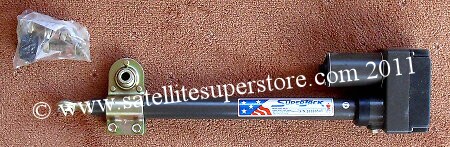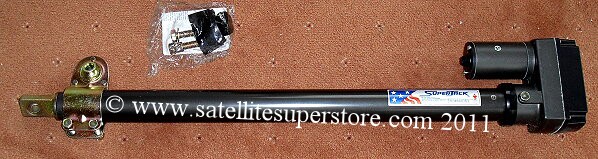


Advice on Diseqc Motors.

This is a development where digital receivers now contain software to control a
Diseqc motor (right hand side in photo) rather
than a hardware positioner board to control a standard 36V motor (left hand side in photo) motor.
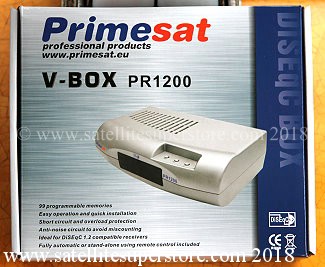
The problems with Diseqc motors and why the "V box" (link to V Box below) is so necessary with larger dishes.
Diseqc is a new development where digital receivers now contain software to control a Diseqc motor rather
than a five amp hardware positioner board to control a standard motor. The motor control works digitally
down the coax signal lead and a 4-wire control system is not required. Also the concept has become an
industry standard. Sounds good so far but what are the drawbacks?
1. Diseqc motors have all been lightweight universal fit motors with a
thirdary rotating pole that the dish clamps to. They are not designed for a particular dish and they do
not properly bolt onto the back of a dish. Slippage can occur in high winds at the thirdary rotating fixing.
2. The coaxial cable is designed to carry the signal from the LNB to the
satellite receiver. It is also designed to provide power to the LNB. The satellite receiver provides about
500 to 600 mA (0.6A) to power the LNB. Typically an LNB might draw about 300 mA. This leaves 200 to 300mA
(0.3A) to power up a Diseqc motor. Clearly a proper hardware (4 wire control system) positioner which
can provide up to (typically) 3 to 5 amps is a far better system as it can drive better bigger, stronger,
quicker motors. With 300mA a Diseqc motor must be very small. The only way a very small motor can move
a dish is by putting a large gearbox on the end of the motor to provide "leverage". This means that
a Diseqc motor moves very slowly from one satellite to another due to the large amount of gearing.
Small motors & thirdary thinner rotating poles which the dish can slip on are far from ideal for use
with even larger dishes (e.g. 1.0m+ or 90cm + in exposed locations.). Storm force winds in the UK can
provide serious wind loads on a motorised dish. You really do not want to be worrying about whether the
dish is going to come down every time it is windy.
Our opinion of a recent conversation,
I was talking to another dealer the other day. He said he fits a Diseqc motor to the Channel
Master 1.2m dish face. The Channel Master is a heavy dish and the wind loads on a 1.2 can be massive.
In addition, this Channel Master dish is available with a wonderful heavy duty Channel Master
polar mount and actuator (or the big 15 Kg 1224 Supermount H to H motor. See our motorised dishes page.
link below) and yet this dealer fits a (i.e small - usually 3 Kg) universal fit thirdary rotating
pole Diseqc motor to this excellent 1.2m dish face!!! It is like ordering a 6.5 litre Rolls Royce
from a dealer and saying "will you please fit a 1 litre Scoda engine before supplying it."
Absolutely crazy! Unfortunately 99% of dealers (and the magazines) are prepared to go down
this route. What we need is a bit of common sense. Why is wind load never considered? Every year we see
numerous insurance claims. We have never seen a Diseqc motor yet that we would put on a dish of over 1.0m
Our recommendations.
For motorised use, The Diseqc motor works fine on steel dishes up to 90cm and aluminium dishes up to 1.0m
in "normal" locations. For larger dishes, or exposed locations (e.g. above the gutter on a high pole
or on the west coastline of Scotland or Ireland,) use a V Box and a 36v motor.
The V Box will enable heavy duty (non Diseqc) motors to be used that move the dish quickly and efficiently
without the dangers of breakage or slippage in high winds. (motors that properly bolt onto the back of a dish)
We never make recommendations without explaining the facts and the facts are based on the laws of Physics.
Hopefully you will realise that we are making sense.
THE V BOX PAGE.
Latest Diseqc motor information 17/01/04
We have tested a new "Cryptic" Diseqc motor last weekend.
The reason for testing it was that for the first time a motor became available
that bolted onto the back of a 1.0m aluminum dish. Being a Diseqc motor
it was expected that it would still be slow (and it is) but this looked
very promising as the big problem of “universal fit – fits nothing properly
and slips in the wind had been overcome. We really wanted this solution
to work for us. It was set up with a Digiquest 8000 and using the USALS
facility all satellites were programmed in. Looked great.
However !
Taking hold of the edge of the dish, (at a distance of about 0.5m from the centre
Of rotation) there was play (movement) of about 7 mm. This was found to be in
The actual motor shaft between the rotating output shaft and the motor body
(i.e. in the gearbox) Looking at the shaft the movement was about 0.5 of a degree.
Now - last Saturday there were moderately winds (not gale force) and the dish
Moved on and off the satellite (no signal) every few thirds. Not a “peaky”
Low power satellite! We were on the Hotbird.
We contacted the supplier and were told that there is a certain amount of play
In all Diseqc motors as they use a worm drive to gear them down.
(small low current motor – large gearbox)
The only time you might get play in a 36 volt motor is when it has been used every
day for many years.
Dish sizes disclaimer.
Please not that dish sizes vary.
Manufactures quote a particular size of dish, however, dishes are not circular, they are
oval and the dish diameter referred to in their literature and on our site is an
approximation and should not be taken as an exact dimension.