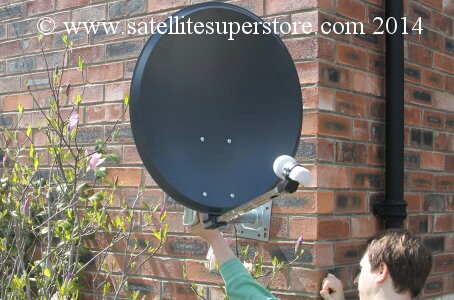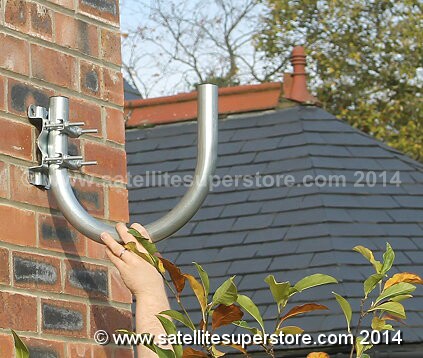


This is heavy galvanised steel mount and is ideal for the 1.0m and 1.1m dishes where
the wall points south east or south west. There is enough stand off for the larger
dish to be at right angles to the wall pointing up or down the street.
It is a low cost solution for most situations.
50mm (2") diameter south facing wall mount (elbow). 500mm stand-off. 4 bolt fixing.
UK delivery on this item is £10. Select the £10 shipping option.
Advice - Using a Sky box as well.
If you look at the twin LNB option above at you will see this issue is dealt with.
i.e. Using a twin LNB in the 28E position, you could have the twin and 2 single
LNBs on 28E, 19E and 13E
Using the FTA / CI receiver on one output of the twin and the 2 single LNBs
all three satellites will then work on this receiver.
The second output of the twin could go to the Sky Digibox
Alternatively, without the twin option, the FTA / CI receiver could connect to 2 satellites,
19E and 13E. Then the Digibox to the 28E LNB
Either way, two cables must be brought into the house for the 2 receivers.
Advice - Using all four LNBs,
The Triax multisat dish kit can be used on any part of the Sky but in the UK the
common satellites to point it at are 28E, 19E and 13E (or 28E, 19E and 16E or 28E, 16E and 13E
but for these two options a 90cm dish is needed as 16E is a lower power satellite than the other
three satellites) We used to say you cannot get 28E, 19E, 16E and 13E as, even with narrow feed LNBs
you cannot get 3 satellites that are only 3 degrees apart. The narrow feed LNBs can
(unlike standard LNBs) get close enough together to get 19E and 16E or 16E and 13E - here
the LNBs must touch each other to do this. But to get 19E, 16E and 13E, with all three LNBs
touching each other, they are not close enough together. To put it another way, if you set up
one LNB on 19E and another LNB on 13E, a third LNB on 16E will not fit between the other two LNBs.
Therefore, used in this part of the sky for these satellites we used to say that three LNBs would be
used on 28, 19E and 13E and the fourth LNB would be a spare (it is part of the kit). Recently our engineer
did a little experiment. We should point out, however that this would invalidate the warrantee on three
of the LNBs! With a craft knife he shaved some plastic off the sides of the narrow feed LNBs to make
them narrower. The plastic is quite thick and so this is possible without going right through the casing.
He was then able to get 28E, 19E, 16E and 13E perfectly on a 90cm Triax dish.
Up to you!
Here is an e-mail with photos from a
customer, 20th April 07.

I have some interesting photos which you might like. When I was making the arrangement
to get them 3 degrees apart, it was a most interesting exercise! It was, however, well
worth the effort. I have 13, 16, 19.2 and 23.5E all coming in strongly.
James in Brigg, North Lincolnshire.
Our comments - James has done a good job here. He has even made a
small modification. Notice the aluminum bar along the top of the LNBs to
improve rigidity.
Advice - using the Triax Multibracket in France.
(This is NOT an issue in the UK where the bracket works fine on an 80cm dish. - although in the
north a 90 is recommended)
To get Sky / 28E in France you need a 60cm in the North, 80cm by the time you get to Paris
and a 90cm in the south and south west.
(We quote dish sizes to receive the lowest power channels like the BBC although smaller dishes
will work on a % of the channels but not the lowest power.)
Astra and Hotbird are powerful in France and probably only need a 60 for either.
So using a 90cm dish and multibracket in the south is then a problem as you are sharing
the signal between 3 satellites and there is therefore a drop in signal of maybe 3 to 6 dBs
on LNBs not in the centre of the boom arm. (centred on 19E, the 28E LNB is off-centre)
It therefore follows that a bigger dish is needed to make up for losses in a lower signal areas like France etc.
A solution, in theory, might be the Triax 1.1m dish which is also compatible with the multibracket
but we have had no sales of that type and hence no feedback from customers to confirm it works well in that area.
Also note that on the mutibracket page there is a twin option so that a twin LNB can be put in the 28E position
on the bracket so that a Sky Digital can be used as well as a CI receiver.
Advice - using the Triax Multibracket in Spain.
CUSTOMER FEEDBACK.
Good morning,
Having spent a lot of time visiting your site, I would like to pass on some information to you regarding an
installation that I have finally sorted out.
I live on the Costa Brava in the town of Roses; and for some time wanted to view Astra 1 and 2
using the same dish- despite attempting a motorised system and two separate dishes, I was never
able to see both the Spanish Digital + system on Astra 1 and the FTA channels on Astra 2 well enough.
So I purchased a Triax 110cm dish, a multi lnb bracket, and a VisionNet FCIS 7000 reciever. I now have
over 300 FTA channels on Astra 2, all the Spanish system, and the added bonus of all the new Spanish
freeview system. It has a taken a little bit of patience, but as now I have 95% signal quality on
the FTA channels on Astra 2 ( in fact, better than Astra 1 at about 75-80%), I am more than happy.
I know that you have requested any feedback regarding Triax and their multi-lnb bracket; well, please
advise all those who are thinking about purchasing or installing, that here in northeast Spain, the
results are spectacular.
Thank you for your time, keep up the good work.
Regards,
Patrick
Feedback from Ireland
Feedback. I got a 90cm Triax Dish, Diseqc switch and multi-arm bracket from you last year
and it is working a dream in Dublin - I use 3 of the LNBs for Hotbird, Astra 1 and Astra
2/Eurobird.
By the way, when setting up the multi-arm I found that the maximum 'tilt' of the arm was
quite limited and was insufficient to get a good signal from the 3 satellites.
Must be the vertical angles in Dublin! I had to do a bit of cutting/scraping to
increase the tilt but it works great now (~80-90 signal from Astra 1 & Hotbird
and over 90% with Astra 2). Regards, Dominic
Advice - using the Triax Multibracket with other dishes.
Over the last 10 years we have tried a number of universal 20 degree kits and none of them worked
properly - producing very low signal on all satellites - often flexible plastic and poorly made.
In 2005 Triax introduced the multibracket kit for the range of TD dishes.
We were skeptical but we tested it and it worked well.
Please note the following,
The Triax Mulibracket.
It is a precision engineered aluminum extrusion design.
It fits the Triax Boom arm and not other arms.
The design program was to match the arm to the dish so that they work properly together.
1000s sold and customers know they work
It may work properly on other dishes and will not fit anyway.
That is not to say that if you put your mind to a modification to make
if fit other dishes that this could not be done. Anything can be achieved
with a little work and skill but we certainly cannot comment on whether
a DIY mod will provide good results.
BUT
After 6 months of work and testing we have adapted it to our clear transparent 85cm
dish and it works very well. This modified unit is now available and good feedback
has come in from users.
Problems of using more than one diseqc switch
with multiple LNBs
One our web site you will find 2, 3 and 4 LNBs on one fixed dish
See
2, 3 or 4 satellites on 1 fixed dish
You will also find options for the fitting of a twin or quad LNB as a substitution
with ONE of the 3 or 4 LNBs so that a popular satellite can go to several receivers.
e.g. putting a twin or quad in the 28E position so that a Sky digibox or Sky + can
be connected as well as the CI receiver to that LNB That means the CI receiver and the
Sky box both are connected to 28E but the CI receiver is also connected to other
satellites through ONE diseqc switch.
You will not find on our site 2.3 or 4 satellite kits with twin or quad LNBs and
more than one diseqc switch to either two receivers or a twin tuner receiver.
REASON.
Whilst it should all work in theory, in practice
(depending on the combination of switch positions) you can get no signal on a
satellite when it should all work. This is because twin LNBs and Quad LNB should
be fully connected to work properly. It may be OK to connect to two outputs of a quad
but you have to experiment to find out which two. With a twin, one side has a good
connection to the internal power supply circuit and the other is almost like a passive
device and relies on power from the second receiver to work properly
If you connect two or more diseqc switches, they take power away from some of the
outputs of the twin or quad LNBs (depending on the switching at the time) and
things go wrong.
IS THERE A SOLUTION?
Yes there is - a new solution - but quite expensive. It will be on our site soon as
an option on all of the twin tuner receiver pages eventually but see it at
multiswitches
The 9 in and 6 out and the 17 in an 6 out ...etc. This is a product designed to
do the job. Quatro LNBs must be used but all the switching is done inside the unit
and there are no power issues
One of the problems with 16E is that it needs a 90cm dish and really needs the LNB to
and on the push fit holder, the LNB can then sit in the centre of the boom arm.
This provides more signal for 16E. It is also a useful mod for any other combination
of satellites where a weak one among the 4 needs to be prioritised for max signal.
The picture on the left shows where the cuts are made, the clamp is then pushed to